

Could Almería City Be Spain’s Next Málaga or Alicante?
We have many clients with one , two or three rental properties in Malaga and Alicante city who are hearing about the changes happening in Almeria and wonder if it is time to invest as the prices are so much lower. We have had an office on the main high street of Almería and know the city very well. This is what I think about this :
For thirty years, foreign buyers looking at Spain’s Mediterranean coast have followed a familiar script: Málaga and Alicante get discovered, prices climb, and the “hidden gem” reputation quietly disappears along with the parking spaces. Almería city has never really featured in that story. It has the same coastline, the same 320-odd days of sunshine, and a historic centre with genuine character — yet for decades it has been the coastal capital everyone drove past on the way to Mojácar or Cabo de Gata, barely glancing in the rear-view mirror.
That may be starting to change. Almería is investing heavily in its centre, tourist numbers are climbing faster than almost anywhere else in Andalucía, and prices are still a fraction of what buyers pay in Málaga or Alicante. Every estate agent on the Spanish coast has, at some point, described somewhere as “the next Marbella,” usually about a village with one bar and a donkey. So lets see if the Almería comparison actually holds up, or whether it’s the same old sales patter with better weather stats.
What’s changing in Almería
The city council has committed to an urban regeneration programme, “Almería Ciudad Abierta y de Encuentro 2030,” worth more than €14 million through 2029, aimed at the historic centre and its heritage sites. The Alcazaba — the 10th-century Moorish fortress that dominates the skyline and gives the best sunset view on this stretch of coast, sunset views being a genuinely competitive category around here — has had its approach areas redesigned to open up sightlines to the monument.
The main artery through the centre, El Paseo de Almería, (where our office is ) together with the adjoining Rambla, has been undergoing pedestrianisation since January 2025, with the works designed to create a continuous walking route linking the centre to the port. That port is the subject of a much bigger project: a €24 million tender to remodel the Muelle de Levante into a cruise terminal and public space, with a proposed hotel tower as part of the redevelopment. Completion is pencilled in for around 2029, which in Spanish public works terms means “sometime this decade, possibly the next one” — a caveat we’d apply to any timeline in this article.
The tourism numbers are backing this up regardless. Almería province logged its best May on record in 2026, with overnight stays up nearly 12% year on year and foreign visitor stays up over 25%. Hotel occupancy has been running close to 75%. It’s genuine, above-trend growth — the kind of momentum that, in Málaga’s case, eventually pulled in international buyers rather than just backpackers looking for a cheap tapa.
And the tapas are, incidentally, part of the pitch: Almería is one of the last places in Spain where a free tapa still turns up automatically with every drink, no ordering required. It’s a small thing, but it’s the kind of small thing that makes a city feel like it’s still for locals rather than for tourists — which, depending on your investment thesis, is either the charm or the risk.
The price gap is real
This is where the “next Málaga” comparison has teeth. As of mid-2026, Almería capital was trading at roughly €1,680–1,700 per square metre — well below the Spanish national average of around €2,820/m². Alicante city hit a record €2,515–2,830/m² in 2026, up 8–9% year on year. Málaga capital has gone further still, at roughly €3,800/m², a rise of over 65% in six years, making it Spain’s third most expensive market behind Madrid and Barcelona.
Put simply: an apartment in Almería currently costs roughly 45% of the equivalent in Málaga, and around 60–65% of the equivalent in Alicante. If Almería ever closed even part of that gap, the returns for early buyers would be substantial. If it doesn’t, you’ve still bought a nice flat near the beach for the price of a garage in Málaga.
Why in my opinion the comparison is imperfect
The gap alone doesn’t tell you whether it will close. Málaga’s rise wasn’t just tourists discovering a pretty city — it was a specific combination of a well-connected international airport with decades of low-cost routes, a long-established British and Northern European expat community, and, more recently, deliberate investment in tech companies through the Málaga TechPark. Alicante has similarly ridden its airport’s connectivity to the UK and Ireland and its long-standing role as gateway to the Costa Blanca.
Almería’s international airport has far fewer direct routes, and the city doesn’t yet have the equivalent expat infrastructure — the schools, professional services, and English-speaking community that make relocation easy rather than an adventure. That’s not a permanent barrier (every expat hub started without one), but it is a real one, and it means Almería’s growth is currently driven more by domestic and short-stay international tourism than by the buyer relocation that repriced Málaga’s residential market.
One detail worth correcting, since we heard it repeated recently: it’s sometimes assumed that Almería, like several other Andalusian capitals, has stopped issuing new tourist rental licences. It hasn’t. Málaga, Sevilla, Granada, Córdoba and Cádiz have all restricted new licences for short-term lets, which has created scarcity value for existing licensed properties in those cities. Almería capital has imposed no such restriction, so licences are, for now, still relatively easy to obtain. That cuts both ways: there’s no artificial scarcity propping up prices for licensed properties today, but it also means less regulatory risk for a buyer than in cities that have already tightened the rules — and if Almería does eventually follow suit, existing owners could see the same kind of windfall that early Málaga buyers got.
My best attempt at a balanced verdict
Almería city has real momentum: public investment in its historic centre and port, record tourism growth, and a price level that looks anomalous next to comparable coastal capitals. Those are genuine reasons for interest, not marketing spin dressed up with a filming location and a fortress.
But Málaga’s transformation took the better part of two decades and rested on infrastructure and demographic shifts Almería doesn’t yet fully have. A city can grow tourist numbers sharply from a low base without that translating into the sustained foreign buyer demand that reprices a residential market — plenty of Spanish towns have had one good summer and stayed exactly the same size ever since. Almería’s story right now is closer to “promising and undervalued” than “the next Málaga.” The second half of that comparison hasn’t been earned yet, and nobody can hand you a date for when, or if, it will be.
For a buyer, that argues for treating Almería as a longer-term, higher-risk position with possible high upside rather than a short-term arbitrage. The upside case is credible; it isn’t guaranteed, and there’s no fixed timeline attached to it.
Lawyers are not known for being great investors and I am definitely not providing it here. Recently we have had quite a few seasoned investors who had previously purchased in Malaga buying and others looking into buying rental properties in Almeria as they do see the opportunity. I hope that they are correct as among other things it will be great for our Almería office.
Beyond the spreadsheets: what to see while you’re there
Whatever you decide about the numbers, Almería rewards a wander, and it has more going on than most first-time visitors expect.
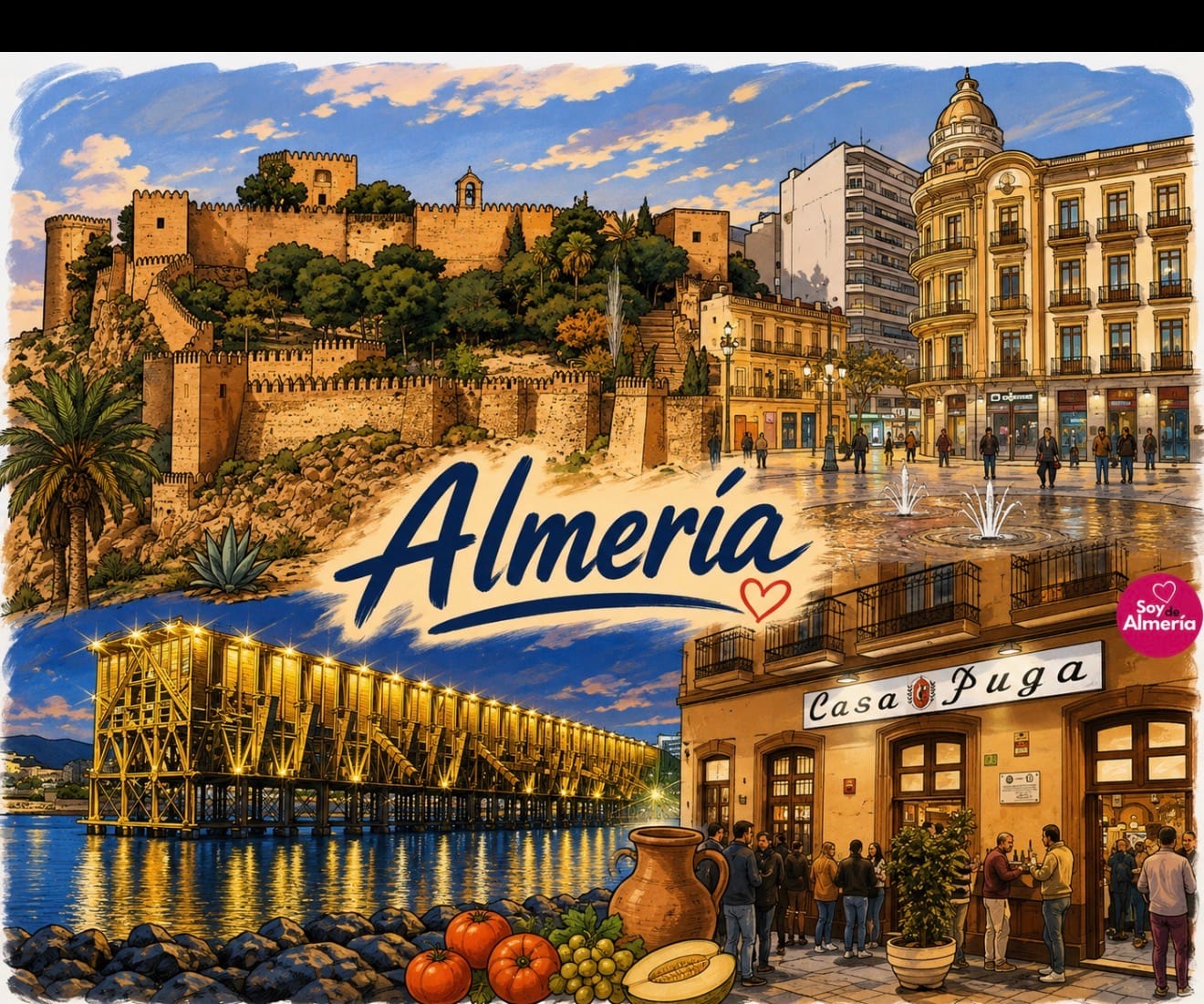
The Alcazaba. One of the largest Moorish fortresses in Spain, bigger than the Alhambra in surface area if not in fame, with terraced gardens and a view over the port that has ended more than one property viewing with someone quietly asking their lawyer to draw up an offer.
The Cathedral-Fortress. Built to double as a defensive stronghold against Barbary pirate raids, which explains why it looks less like a place of worship and more like something designed to withstand a siege — because it was.
The Refugios de la Guerra Civil. Almería was heavily bombed during the Spanish Civil War, and the city responded by digging over four kilometres of underground shelters. Genuinely sobering, genuinely worth the hour, and a useful reminder that “historic city” doesn’t always mean postcard views. The building my office is in Paseo number 4 is one of the very few private buildings that has a direct access to the 4 kms of underground shelter.
Cable Inglés. A 100-year-old iron loading pier built by British engineers to ship ore straight from train to boat, in the architectural style associated with Gustave Eiffel’s school. It’s since appeared in various films shot along this coast — this stretch of Andalucía doubled for the Sahara and the American West more times than most Almerienses can be bothered to list.
The Tabernas Desert film sets, a short drive out of town. Sergio Leone shot the classic Clint Eastwood “Dollars” westerns here, and Indiana Jones and the Last Crusade filmed scenes nearby. Europe’s only true desert, and the reason half the spaghetti westerns you’ve seen were, geographically speaking, Spanish. Great for kids .
Old market of Almeria ( Good place to eat and drink)
Barrio de la Chanca. A cluster of brightly painted cave houses climbing the hillside above the port — not polished for tourists, which is exactly why it’s worth seeing before it inevitably is. Recommended on tourist maps, but I do not recommend visiting until they polish it all up a little and make it safer for tourists.
Plaza Vieja and the Paseo. The elegant arcaded main square and the newly pedestrianised high street, both good places to test the local tapa-with-every-drink tradition, purely for research purposes.
Playa del Zapillo. The city beach, a short walk from the centre, with none of the queues you’d find on an equivalent stretch of the Costa del Sol in August — for now, at least.
If you are going visit just one Tapa Bar, fight for your place at the bar of Casa Puga. The mos
A note for buyers and existing owners
If you’re considering a purchase in Almería, the fundamentals of buying property in Spain as a foreign national don’t change because a city is “up and coming” — proper due diligence on the title, planning status, and any debts attached to the property matters just as much here as on the Costa del Sol. And if you already hold Spanish assets, rising local valuations are a good prompt to revisit whether your will still reflects what those assets are actually worth. We’re happy to advise on either.
This article is intended as general information, not investment advice. Property values can fall as well as rise, and past performance in comparable markets is not a guarantee of future results in Almería.
