Inheriting Property in the Balearic Islands: A Guide for British, Irish, American, Canadian and Australian Beneficiaries
If you are reading this, the chances are that someone you loved has recently passed away and left you a property, or a share of a property, in Mallorca, Menorca, Ibiza or Formentera. You may be dealing with this from thousands of miles away, grieving, unsure of the Spanish system, and wondering where on earth to start. I want to reassure you at the outset: what you are facing is entirely manageable, it is something we deal with every week, and there is genuinely good news waiting for you further down this page regarding Balearic inheritance tax.
My name is Michael Davies. I am a Spanish lawyer member of the law societyes of Madrid and Almería. , founder of Davies Abogados, and I have practised law in Spain since 1994 — over thirty years — acting mainly for English-speaking clients from the UK, Ireland, the USA, Canada and Australia who are either inheriting Spanish property or need to put a Spanish will in place to protect the people they love. We handle inheritance matters across the whole of Spain, including the Balearic and Canary Islands, and this guide draws directly on that experience.
This article is written for two groups of readers, and if either applies to you, please read on:
- You have been told you are a beneficiary of an estate that includes property, a bank account, or other assets in the Balearic Islands, and you need to understand what happens next.
- You own property in the Balearics and have started to wonder — often after receiving a link like this from a friend — whether you need a Spanish will of your own.
A procedure needs to take place in Spain to transfer the Spanish assets , Whatever Your Home Will Says
The single most important fact to understand as a beneficiary is this: a property located in Mallorca, Menorca, Ibiza or Formentera the formalities are dealt with under Spanish legal and tax procedure, regardless of the deceased’s nationality, regardless of where they were living when they died, and regardless of what a UK, Irish, American, Canadian or Australian will says about it. An English grant of probate or an American letters of administration does not, by itself, transfer title to Spanish property. It is a vital piece of evidence if there is no Spanish will , but the transfer itself has to happen in Spain, before a Spanish notary, followed by registration at the Spanish Land Registry (Registro de la Propiedad), tax clearance in Spain etc.
This surprises a lot of families. It is not unusual for a UK solicitor to complete the English side of an estate and assume the job is done, only for the family to discover months or years later that the Spanish property is still registered in the name of someone who has died. That has knock-on consequences for local property tax (IBI), for selling the property later, and — as we come to below — for the inheritance tax clock, which does not wait for you.
The Genuinely Good News: Balearic Inheritance Tax Has Been Almost Eliminated for Close Family
For many years, Spanish inheritance tax — Impuesto sobre Sucesiones y Donaciones, or ISD — was a real worry for the families of foreign property owners on the islands. That picture has changed dramatically, and if you are a spouse, child, grandchild or parent of the deceased, this is the part of the guide you most need to read.
Since 2023, and reinforced by Law 6/2025 of the Balearic regional government (in force since July 2025), the position for close family is as follows:
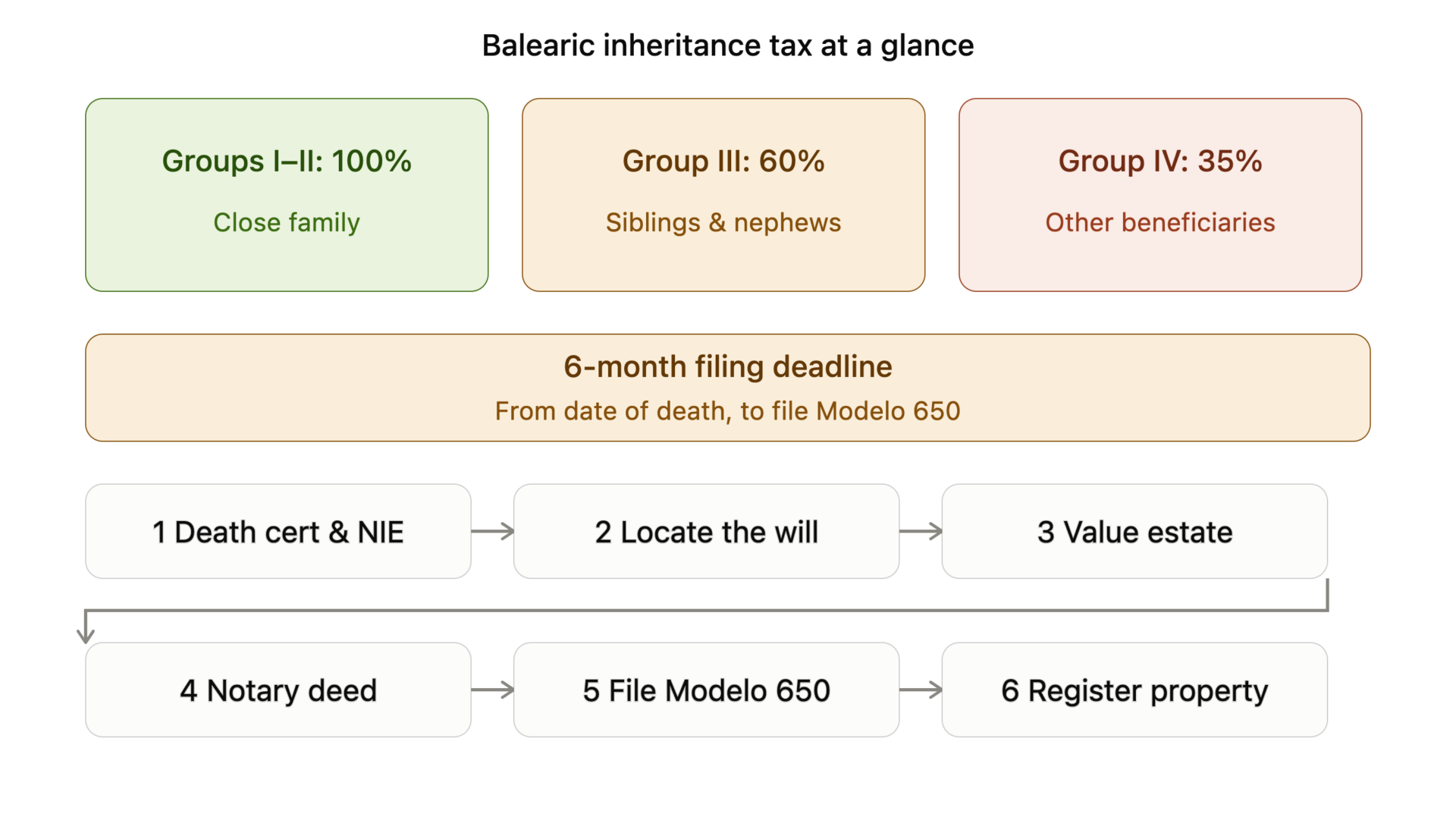
- Group I and Group II beneficiaries — children (including adult children), grandchildren, spouses and parents — benefit from a 100% reduction of the tax liability, with no ceiling on the value of the estate. In practical terms, a spouse or child inheriting a villa in Mallorca or an apartment in Ibiza now pays no Balearic inheritance tax on that inheritance at all.
- Group III beneficiaries — siblings, nephews, nieces, aunts and uncles — benefit from a 60% reduction.
- Group IV beneficiaries — more distant relatives and unrelated beneficiaries — benefit from a 35% reduction.
This is one of the most generous regional regimes anywhere in Spain and more generous than the national default rules. (more about how non-resident beneficiaries no longer fall under the default rules even if they present their inheritance tax clearance documents to the. national tax office where the tax level is higher )
A word of caution for non-resident families. Following a 2014 ruling of the Court of Justice of the European Union and the subsequent change in Spanish law, non-resident beneficiaries — including UK, US, Canadian and Australian citizens who have never lived in Spain — are entitled to the same regional benefits as Spanish residents, and are no longer forced onto the older, less favourable national scale simply because they live abroad. Broadly, the Balearic regime applies where the deceased was resident in the islands, where the heir is resident there, or — commonly for our clients — where the principal asset being inherited is Balearic property. The precise rule that applies to your case depends on the residence history of both the deceased and the beneficiaries, and it is worth having this checked properly rather than assumed, because getting it wrong can mean paying tax you do not actually owe.
Six main Things You Need to Do as a Beneficiary
Even with the tax bill reduced to nothing (or close to it) for most close family, the property does not transfer itself. In our experience, the process generally involves:
- Obtaining an apostilled death certificate and, where one exists, the original will — whether that is a Spanish will or a foreign one.
- Applying for an NIE (Número de Identificación de Extranjero) for each beneficiary, if they do not already have one. You cannot inherit Spanish property without one.
- Establishing the heirs formally. If there is a Spanish will, this is straightforward. If there is only a foreign will or grant of probate, further work is needed, because a foreign grant establishes who is authorised to administer the estate, not necessarily who is legally entitled to inherit under the law that applies to the succession. We deal with this regularly, is is more expensive , more complex (sometimes very ) and always takes longer so it is worth starting early.
- Valuing the property and the rest of the Spanish estate, since the ISD return and the notarial deed both depend on an accurate, defensible valuation.
- Signing the escritura de aceptación y adjudicación de herencia — the notarial deed of acceptance and distribution of the estate — before a Spanish notary. This can often be arranged by power of attorney, so beneficiaries do not need to travel to Spain in person.
- Filing and paying the ISD return (Modelo 650), settling the plusvalía municipal (a separate local tax on the increase in land value), and registering the property in the heirs’ names at the Land Registry.
The Deadline That Catches Families Out
You have six months from the date of death to file the Spanish inheritance tax return, and this deadline applies even to non-resident beneficiaries who have never set foot on the islands. A single six-month extension can be requested, but it must be applied for within the first five months — it is not automatic. Miss the deadline and surcharges begin to accrue, rising the longer the delay continues. There can be fines even where the tax ultimately payable is zero because of the exemptions described above. Because English-speaking families often lose the first few months to grief, an unfamiliar foreign probate process, or simply not knowing where to begin, this is the single most common reason we are contacted urgently rather than calmly. If you take one thing from this article, let it be this: start the Spanish side of the process as soon as you reasonably can, in parallel with anything happening at home, not after it.
If There Is No Spanish Will — Or No Will at All
Some of our clients’ late parents or partners never made a will in Spain covering their Spanish property specifically, relying instead on a UK, Irish, US, Canadian or Australian will, or on no will at all. This is manageable, but it adds real time and cost to the process mainly for two reasons.
First, as noted above, a foreign grant of probate has to be translated into a formal determination of who the legal heirs actually are under the law that governs the succession — either through a court order in the home country or an affidavit of heirship supported by a local lawyer’s opinion on the relevant intestacy law, both Apostilled and translated into Spanish. This often causes problems and the larger the stakes the more strict those involved in the acceptance of the foreign documents will become ( notaries, tax office. property register banks etc ) .
Second, you need to establish which law governs the succession in the first place. Since 2015, EU Regulation 650/2012 (often called “Brussels IV”) allows the estate of anyone who dies owning property in Spain to be governed either by Spanish law or by the law of their own nationality — but only if they made a valid choice to that effect during their lifetime. Without that choice, the default is the law of the deceased’s last habitual residence, which for a long-term Balearic resident may well mean Spanish succession rules apply by default. This is exactly the situation a Spanish will is designed to prevent.
Intestate procedures are sometimes required and I woudl need
Property Owners: The Best Half Hour You Will Spend This Year
If you have read this far because you own property in Mallorca, Menorca, Ibiza or Formentera rather than because you are currently dealing with an inheritance, I hope the sections above have made the case for you better than I could. A Spanish will:
- Lets you formally elect the law of your own nationality to govern your Spanish estate under Brussels IV, so your family is not left second-guessing which country’s rules apply at the worst possible moment.
- Sits alongside your UK, Irish, US, Canadian or Australian will (each dealing with assets in its own jurisdiction) rather than replacing it, so the two do not conflict or accidentally revoke one another.
- Allows your executors and heirs to prove their entitlement to a Spanish notary quickly, using the Spanish Central Registry of Wills, instead of navigating a foreign heirship process from scratch.
- Is typically inexpensive to prepare and sign in Spain, and can save your family many months of delay and a great deal of avoidable cost.
It is one of the few pieces of estate planning where the cost of doing it now is trivial compared with the cost, in time, stress and money, of leaving it to your family to sort out later — often from another country, often while grieving, and always against the clock of that six-month deadline.
Frequently Asked Questions
Do I have to pay Spanish inheritance tax if I live in the UK, USA, Canada or Australia and have never lived in Spain? Potentially, but for spouses, children, grandchildren and parents inheriting Balearic property, the current 100% regional reduction generally means the tax payable is zero or close to it, regardless of where you live. The exact position depends on the residence history of the deceased and the beneficiaries and should be confirmed for your specific case. In all cases you need to apply and obtain inheritance ta clearance within six months .
How long do I have to deal with an inheritance in the Balearic Islands? Six months from the date of death to file the tax return, with a possible four-month extension if requested within the first five months. Registering the property and settling other formalities can continue after that, but the tax deadline is the one to protect first.
Can I inherit if the deceased did not leave a Spanish will? Yes. A foreign will or a foreign grant of probate can be used, but it needs to be apostilled, translated, and — usually — supplemented with formal evidence of who the legal heirs are under the applicable law. This adds time, which is exactly why we recommend a Spanish will to clients who currently have none.
I am a British national — does Brexit change any of this? No. Spanish succession and inheritance tax rules for UK nationals are unaffected by Brexit; the relevant framework is EU Regulation 650/2012 and Spanish tax law, both of which continue to apply to British owners and beneficiaries in the same way as before.
Should I make a separate Spanish will, or update my will at home to cover my Spanish property? In our experience a dedicated Spanish will, limited to your Spanish assets and drafted to work alongside your home-country will, is the cleanest and most reliable approach, and is what we recommend to the great majority of our clients.
How We Can Help
Davies Abogados has represented English-speaking beneficiaries and property owners across Spain, including the Balearic and Canary Islands, since 1994. We work daily in both English and Spanish, we understand the practical realities of coordinating a Spanish inheritance with a UK, Irish, US, Canadian or Australian estate, and we are used to guiding clients through this from abroad, often by power of attorney, so that travel to Spain is kept to a minimum.
Whether you have just learned that you are inheriting a property in Mallorca, Menorca, Ibiza or Formentera, or you own property there and have been meaning to sort out a Spanish will, please get in touch. We would be glad to talk it through with you.
This article is intended as general guidance based on the rules in force at the time of writing and does not constitute individual legal or tax advice. Balearic and Spanish tax rules are subject to change, and the position for any particular estate depends on its specific facts. Please contact us for advice tailored to your circumstances.